
What Little Shop of Horrors Taught Me About Social Media Marketing
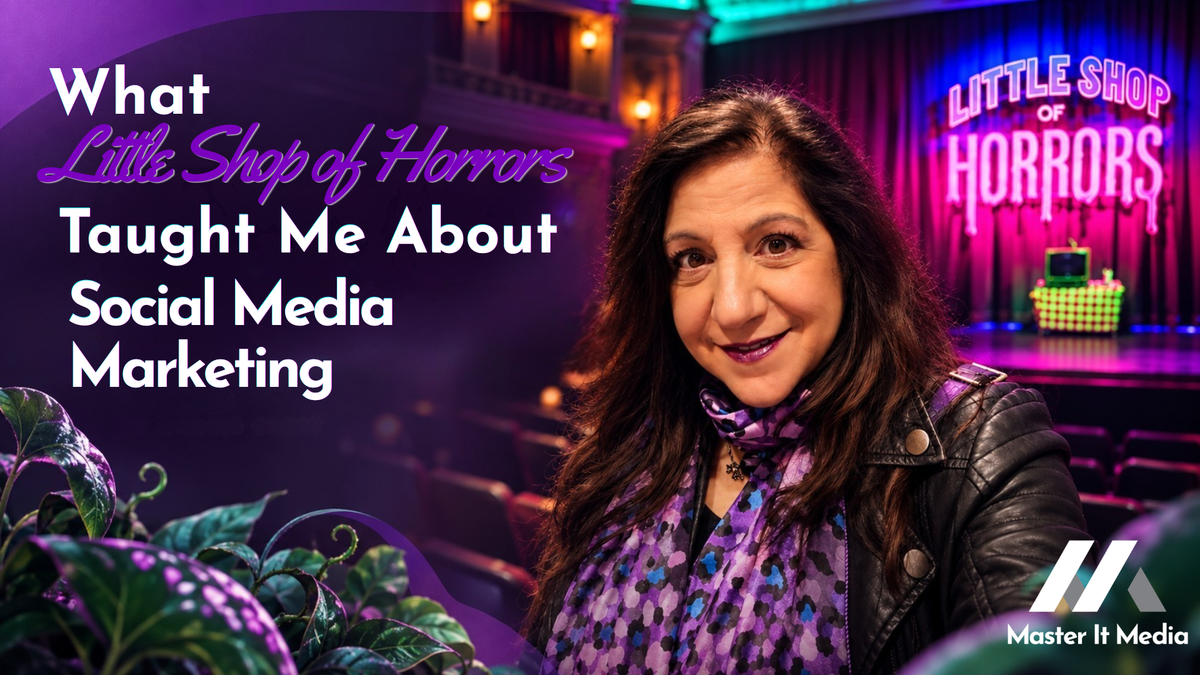
Little Shop of Horrors had been on my radar for a while.
I wanted to see the Off-Broadway production. I knew about it. I was interested.
But I hadn't bought a ticket.
Think about that for a minute from a business perspective. How many people are sitting in your audience right now who already know who you are? They've followed you, visited your website, read your emails, or thought about working with you.
They're interested, but something hasn't moved them to take that next step.
For me, that something was a social media post.
I follow performer Teddy Yudain, whom I've known since he was a kid. Decades ago, when I was doing theater in Connecticut, I knew his parents. I've loved watching his career and seeing someone I actually knew treading the boards in New York.
When Teddy posted that he was coming back to Little Shop of Horrors for a short stint as the dentist, that was it.
I bought the ticket.
 And once I got to the theater, my social media strategist brain kicked in.
I started noticing what was happening around the show, from the people talking about it online to the audience posts displayed in the lobby, the photo opportunities, partnerships, branding, and even the way fans were using the show's language themselves.
What I saw was one of the smartest, most layered social media strategies I've come across in a long time.
And almost every lesson can be applied to a business that has absolutely nothing to do with theater.
1. Let the People Closest to Your Business Help Tell the Story
The official Little Shop of Horrors social media account wasn't what finally sold me a ticket.
Teddy's post did.
That's an important distinction.
A business tends to think about social media as its official account talking to its audience. But there may be many more people around your business who can naturally extend that reach.
With Little Shop, it's not only the actors. Stage managers, designers, production staff, and other people connected to the show have their own audiences.
And those audiences are different.
Teddy's parents follow him. His theater friends follow him. I follow him. Other cast and crew members have their own circles of people who care about what they're doing.
Instead of one account trying to reach everybody, you suddenly have dozens of people introducing the show to their own communities.
Think about who is already close to your business. Your employees, clients, vendors, collaborators, community partners, and even family members may have people in their circles who would never discover you through your company account.
You don't need to hand everyone a promotional script.
In fact, please don't.
Make it easy and natural for the people connected to your business to talk about what they're already part of.
That's exactly what got me through the theater door.
2. Make Your Social Proof Something People Want to Join
Most business owners understand social proof as testimonials and reviews.
Those are important.
But Little Shop took the idea one step further.
In the theater lobby, they created an actual bulletin board displaying printed social media posts from people who had shared about the show.

So while you're standing there waiting for the performance, you're seeing real people talking about their experiences.
Then it gets even better.
People want to make the board.
They post about the show and can look to see whether their post gets featured. What could have been a simple display of testimonials becomes something the audience gets to participate in.
That's a very different experience from putting a testimonial graphic on your website and forgetting about it.
Think about how you could make your customers part of the story.
Maybe you regularly feature customer photos. Maybe you have a client spotlight. Maybe you reshare customer posts and tag them. If you have a physical location, perhaps there's a way to display customer stories there.
You don't have to build a bulletin board.
The bigger lesson is to recognize the people who are already talking about you and give them a reason to keep doing it.
3. Create Moments People Naturally Want to Share
The lobby wasn't finished teaching me yet.
There were also photo opportunities designed around the show, with recognizable branding and a backdrop people could use for pictures.
Of course people are going to take photos when they go to a show.
So why not make it easier for those photos to become part of the marketing?
The same idea could work for a restaurant with a beautifully presented dish, a coffee shop with a great mural, a boutique with an interesting window display, or a salon with a backdrop where clients can photograph their finished look.
It doesn't need to be elaborate.
It needs to feel natural enough that people want to include it in something they were probably going to share anyway.
And here's where branding matters.
If you have a physical space, think about what appears in the background of those pictures. Is your logo there? Your social media handle? Your website? Something recognizable about your brand?
Even when someone forgets to tag you, the photo can still point back to your business.
Don't just ask people to share. Give them something worth sharing.
4. Pay Attention When Customers Start Using Your Language
Little Shop consistently uses recognizable imagery, phrases, and references from the show in its marketing.
But what fascinated me was seeing the audience start doing it, too.
People were using phrases like “Don't feed the plant” in their own posts and reviews.

I'm not going to tell you exactly what that means.
You'll have to go see the show because it's amazing.
But from a branding perspective, this is what caught my attention: the audience had adopted the language.
It had become an inside joke. If you know, you know.
That doesn't happen because someone writes “Please use our branded phrase in your Instagram caption.”
It happens when your brand is consistent enough that people remember the language and want to use it themselves.
Listen to your own customers.
Are there phrases they repeat back to you? Do clients use one of your expressions when they're explaining your process to someone else? Is there something you say often enough that people immediately associate it with you?
Pay attention.
Those little phrases can become part of the community that develops around your brand.
5. Find Collaborations That Actually Make Sense
This may have been one of my favorite pieces of the entire strategy.
Little Shop has collaborated with organizations and businesses outside the obvious theater world.
There have been plant-related partnerships, educational projects inspired by Audrey II, and even a real Manhattan flower shop transformed into a version of Mushnik's flower shop from the story.
At first glance, a florist and an Off-Broadway production may not seem like an obvious marketing partnership.
Then you remember that Little Shop of Horrors takes place in a flower shop and features a rather memorable plant.

Suddenly it makes perfect sense.
That's the part I want business owners to think about.
When you're considering a collaboration, don't only look at businesses that do exactly what you do.
Look for the thread.
If you're a photographer, perhaps there's a natural connection with a wedding planner. If you're a financial advisor, there may be opportunities with an estate attorney. A restaurant might find an interesting connection with a local farm, event venue, or food producer.
A good collaboration gives both audiences a reason to understand why you're together.
Ask yourself who has a genuine connection to your customers, your story, your service, or the problem you solve.
Sometimes the best partnership isn't the most obvious one.
6. Treat Relationships Like They Matter, Because You Never Know Where They'll Lead
Then there's the Ariana Grande story.
When Liz Gillies was starring as Audrey, Ariana Grande, her longtime friend and former Victorious co-star, came to see the show with Ethan Slater.
Liz shared backstage photos from the visit. Ariana brought little potted plants for the cast as a nod to Audrey II, and the story spread across entertainment and fan media.

And now here's where the story gets especially interesting.
Ethan Slater later joined the production as Seymour.
I'm not suggesting that Ariana's visit caused that casting. That's not something we know.
But I love what the sequence reminds us about relationships.
Someone can show up as a supporter today and become part of the story later.
You have no idea where a client relationship, introduction, collaboration, referral, event attendee, or conversation might eventually lead.
That's why the people who show up for your business should matter before you know what they can do for you.
Relationships have a much longer shelf life than a social media post.
7. Give People a Reason to Revisit Your Story
There's another layer of Little Shop buzz happening this year that isn't part of the current Off-Broadway production.
The original 1986 film is celebrating its 40th anniversary, creating another reason for people to talk about Little Shop of Horrors.
That reminded me of something businesses often overlook.
You don't always need a brand-new idea to have something worth talking about.
An anniversary, milestone, original product, first client, business birthday, old photograph, or story about where you started can bring something from your past back into the conversation.
Maybe you're celebrating one year in business.
Maybe you've reached your 100th client.
Maybe you found a photograph from your first office and can compare it with where you work today.
Those stories give people another way to understand how your business has grown.
Your history is content, too.
The Marketing Only Works Because the Experience Works
Here's the part that ties all of this together.
None of these ideas would matter if the show weren't good.
The actors still have to perform. The musicians have to play every note. The crew has to make everything work backstage. The house staff has to make people feel welcome from the moment they arrive.
The bulletin board can't fix a bad show.
Neither can a photo backdrop, a hashtag, a collaboration, Ariana Grande showing up, or a clever social media campaign.
The same is true in business.
Social media can introduce people to you. AI can help organize your ideas. Marketing can create interest. Collaborations can put you in front of new audiences.
But the experience people have with your business is what gives them something worth talking about.
I went to Little Shop of Horrors because someone I knew posted something that interested me.
Everything else I discovered gave that one moment more places to go.
What Does Your Version of This Look Like?
You don't need an Off-Broadway theater, a giant plant, or Ariana Grande showing up in your lobby to use these ideas.
Start by looking at everywhere your business already touches people.
Think about your team, customers, social media accounts, physical location, signage, neighboring businesses, professional relationships, and community.
Where could you make it easier for someone to talk about you?
Maybe you make it easier for your team to share what they're working on. Maybe you feature more customer content. Maybe you create one photo-worthy moment in your business. Maybe you reach out to one potential collaboration partner who has a genuine connection to what you do.
Pick one.
Because the biggest lesson I took away from Little Shop of Horrors wasn't that every business needs more marketing tactics.
It was seeing what happens when all the little opportunities for people to experience, remember, and talk about a business start working together.
And remember where this story started.
I already knew about the show.
I already wanted to see it.
One person's post finally gave me the reason to buy the ticket.
What Could Your Business Be Missing?
Sometimes you're so close to your own business that it's difficult to see the opportunities sitting right in front of you.
If you'd like to talk through what's working with your social media, where there may be opportunities you're overlooking, and what you could try next, you can book an Aha Appointment with me.
It's a real conversation about your business and your social media, so we can figure out what your version of this could look like.
Ready to master your media?
Let's make your social media simple, consistent, and worth it. Book a free strategy call.
Book a free strategy call →