
Steal Your Customer's Words: Use This Simple AI Strategy to Create Content
One of the biggest challenges business owners have with social media is figuring out what to say.
You know your business. You know your customers. You know the problems you solve. But when it comes time to turn all of that knowledge into a social media post, suddenly the words don't come quite as easily.
The good news is that you may already have the words you need.
They are sitting in your Google reviews, LinkedIn recommendations, emails, text messages, DMs, comments, and conversations with customers. Your customers are telling you what mattered to them, what they were worried about, what surprised them, and what changed after working with you.
That language isn't valuable only for testimonials.
It can become some of your best social media content.
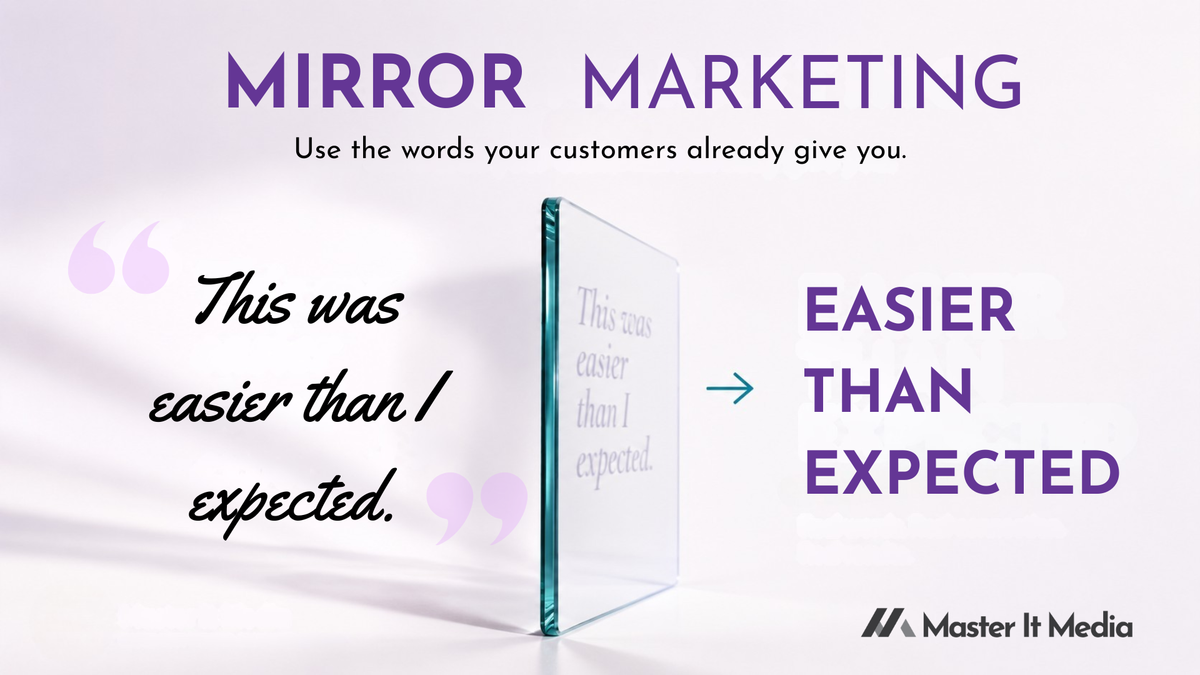
I call this mirror marketing. Instead of trying to invent the perfect marketing language, you listen to the words your customers are already using and mirror that language back in your content.
Here is how to put it into practice.
1. Gather the Customer Language You Already Have
Start by collecting real feedback from your customers.
You don't need a complicated system. Open a document and begin copying and pasting the feedback you've already received. Look through your Google reviews, Facebook recommendations, LinkedIn recommendations, emails, text messages, DMs, comments, and notes you've taken from conversations.
You don't need hundreds of examples, either.
Five detailed, specific reviews can be far more valuable than 50 generic comments that simply say, "Great job!"
As you collect them, pay attention to what your customers are actually saying. What were they worried about before working with you? What surprised them? What made the experience easier than expected? What results do they mention repeatedly?
Maybe you start noticing phrases like, "This was so much easier than I expected," "I finally feel like I know what I'm doing," or "I can't believe I waited this long."
Those aren't phrases created in a marketing meeting.
Those are the words real people use to describe the problems your next customer may be experiencing right now.
That's what makes them so valuable.
PRO TIP: Consider keeping a simple spreadsheet with the source, pain point, key result, and standout customer language. Over time, this can become a valuable content library.
2. Give AI the Right Job
This is where AI can make the process much faster, but how you use it matters.
A common approach is to open ChatGPT or another AI tool and ask:
"Write a social media caption about my business."
The problem is that you haven't given the AI much to work with. If you give it generic information, you're probably going to get generic content.
Instead of asking AI to invent your message, ask it to identify and reflect the language your customers are already using.

Try giving your AI tool five real customer reviews and using a prompt like this:
You are a social media copywriter specializing in authentic, conversation-focused content. Analyze these five customer reviews and identify the three to five most common emotions, phrases, and outcomes customers mention. Pay particular attention to the words and expressions they use naturally rather than polished marketing language.
Then create three social media captions using that vocabulary and emotional tone. Create one caption that addresses the fear or hesitation customers had before working with me, one that focuses on the transformation or result, and one that uses a customer phrase as the hook.
Keep the content warm, real, and conversational. Avoid corporate-sounding marketing language.
You can also tell the AI which platform you're creating content for so it can adjust the format appropriately.
This gives AI a very different job.
You're not asking it to decide what your customers care about. Your customers already told you. You're asking AI to help you recognize the patterns and turn them into usable content.
That's a much better use of the tool.
3. Build the Content Using the H.E.L.P. Process
Once you've identified the language and themes, you can turn them into a complete caption using my H.E.L.P. Process.
The H.E.L.P. Process is a simple framework I created to help business owners create content that connects and converts.
H: Hook attention. Start with the customer's words, question, or experience.
E: Explore the pain point. Show that you understand the doubt, frustration, confusion, or challenge they're experiencing.
L: Lay out the solution. Explain what can change and how you can help without turning the post into a sales pitch.
P: Prompt the action. Give your reader one clear next step.
Here's an example.
Imagine a customer says:
"I didn't even realize how much I needed this until I was done."
That sentence could become your hook.
You could then explore what the customer had been experiencing before working with you, explain what changed, and end with a clear next step for someone experiencing the same challenge.
A complete caption might sound something like this:
"I didn't even realize how much I needed this until it was done."
That's what one of my clients told me recently, and it stopped me in my tracks.
So many business owners are running on empty, doing all the things but never quite getting ahead of their content.
What changed for her wasn't finding more hours in the day. It was finally having a system that worked while she focused on running her business.
If that sounds like exactly what you need, check out the link in my bio to get started.
One customer comment has now become a complete piece of content.
And because it began with real customer language, you're not guessing about whether the problem resonates.
4. Look for Patterns and Batch Your Content
Here's where mirror marketing can start saving you serious time.
As you collect more feedback, you'll probably notice that certain themes appear again and again.
Maybe several customers talk about how much easier something was than they expected. That's a theme around ease.
Others might talk about getting hours back in their week. That's time savings.
Maybe you repeatedly hear, "I finally feel like I know what I'm doing." That's confidence.
Others may talk about a specific business result or about moving from nervous and uncertain to comfortable and confident.
Each of those recurring themes can become a content category.
Instead of sitting down every Monday wondering what to post, you can use those themes to create several pieces of content at once.
A customer comment about saving time could inspire a post about the problem that was wasting their time, another explaining the system that changed it, another sharing the customer's result, and another giving your audience a practical tip they can implement themselves.
One customer insight can create an entire conversation.
And when you start doing this with multiple reviews, emails, and conversations, you can build weeks of content in one sitting.
Why Mirror Marketing Works
There is a bigger strategy behind this than simply making caption writing easier.
When your content consistently reflects the language your customers naturally use, people recognize themselves in your message more quickly.
Your content sounds more human because it isn't filled with language created solely for marketing purposes.
It can also help you build authority without feeling like you're constantly trying to prove how knowledgeable you are.
You're showing that you understand your customers because you're talking about the problems, concerns, and outcomes that actually matter to them.
Listen to your customers, then use what you learn to talk to more people like them.
AI simply makes that process faster.
Try Mirror Marketing With Five Customer Reviews

You can start putting this into practice today.
Find five strong pieces of customer feedback. They could be reviews, emails, texts, DMs, comments, or feedback you've written down after a conversation.
Put them into your AI tool and ask it to identify the repeated emotions, phrases, concerns, and outcomes.
Choose one of those patterns and turn it into a caption using the H.E.L.P. Process.
Then post it.
That's it.
Once you start doing this regularly, you can repeat the process with more customer feedback, organize the themes you're discovering, and build a content library based on what your audience is actually telling you.
You don't necessarily need better words. You need real words, and your customers may have already given them to you.
Make Your Next Caption Easier
If you want help turning those ideas into social media captions, I created the H.E.L.P. Caption Creator using the same H.E.L.P. Process I use to structure content.
It walks you through hooking attention, exploring the pain point, laying out the solution, and prompting the action so you can turn your ideas into clear, purposeful content without starting from scratch.
Visit HelpCaptionCreator.com to get started.
Related Resources
For a deeper dive into solution-focused content:
- Podcast Episode: Steal Your Customer's Words: Use This Simple AI Strategy to Create Content
- YouTube Version: Watch the episode
Ready to master your media?
Let's make your social media simple, consistent, and worth it. Book a free strategy call.
Book a free strategy call →